Wednesday, July 27, 2016

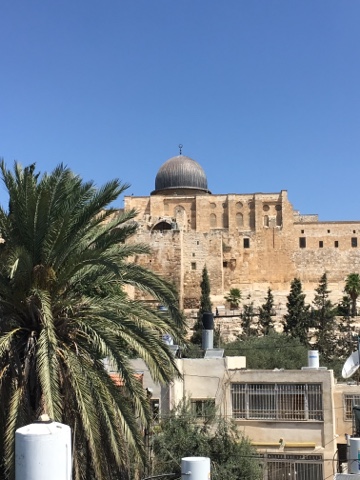
The Mount of Olives


Panoramic View of model of Jerusalem at the Israel Museum
View at Yad Vashem
The past few days have been somewhat of a pause in following the narrative of Luke's gospel.  Yesterday we spent time at the Israel Museum (far too short a time), and at Yad Vashem (a sobering experience).

Today we head to the Mount of Olives, visiting a cluster of churches commemorating Jesus' final few days before the crucifixion.  We will visit Pater Noster (Our Father), Dominus Flevit (The Lord Wept), and the Garden of Gethsemane.  I am looking forward to getting back to spending some time in these holy spaces.

Looking forward, a friend from seminary gave me a tip about our visit...One can ask permission to stay the night (in vigil) at the Church of the Holy Sepulcher.  They take 15 people each night, and give you the admonition, "No sleeping!"  The doors are locked at 9:00pm and reopen at 5:00am. (The key to the church has been in the custody of two Muslim families since the 13th century).  We are about 80% sure we want to spend the night there.  It is not often one has the opportunity...stay tuned.

Only one more post before we head home to Texas.  We have been grateful for your prayers and have kept you, our friends and family, in ours.

With love,
Chris & Bryn

Tuesday, July 26, 2016

Guests of the Waqf


Yesterday came with an exceptional opportunity to visit Al-Aqsa Mosque and the Dome of the Rock.  Since 2000, these sites have been closed to non-Muslims and/or non-Palestinians, yet because of our status as students at St. George's College, we were treated as important guests, entering through a VIP gate and having a guide for our time there.  We were Guests of the Waqf (the trust that owns the buildings).

Pictures cannot capture the beauty of these two buildings...every surface is decorated and everywhere you look you see something new. One surprise, written in Arabic at the top of the Dome of the Rock is a phrase similar to our Nicene Creed - "Jesus, who was born of Mary, died and lives again."


After our visit to these sites, we went to the City of David and Hezikiah's Tunnel.  We took a twenty minute walk in the dark through ankle-deep, ice cold water.  The tunnel was sized much better for Bryn than for me!  You might think this was not a pleasant experience, but the cold water after many days of HOT Jerusalem was very refreshing.  We all agreed we'd do it again.

Today we are off to the Israel Museum and Yad Vashem (the Holocaust Museum).  Our time here is coming close to an end.  We miss you all and send our love.

Peace,
Chris & Bryn


Monday, July 25, 2016

Catching Up

After a few days of early mornings I have fallen behind in reporting our progress.  Sunday we were at Mt. Tabor (the traditional site of the Transfiguration), where our group celebrated the Eucharist just outside of the "official site".   After Eucharist we made our way up to visit the Roman Catholic church constructed on the top of Tabor.  After a short visit to the church and the attached overlook of the valley below, we quickly went back down the mountain to depart for Caesarea Maritima (not to be confused with Caesarea Philippi).  
Caesarea Maritima, built by Herod the Great in order to win favor with Caesar, is a beautiful city on the coast of the Mediterranean.  There are still impressive ruins of the theatre (still in use today), the hippodrome, and other first century buildings.  Others who followed Rome made their mark on Caesarea Maritima, including the Crusader fortress that was one of the last stands for European Christians in the Holy Land.
One might ask, what does Caesarea Maritima have to do with Jesus?...Best I can offer is that there was an inscription found at the site that mentions Pontius Pilate as the governor of Judea. Also Paul, as he traveled the Roman roads, was likely to have been there, perhaps even imprisoned there.  Otherwise it is just a great excuse to stick our feet in the beautiful Mediterranean.
Monday was a day spent at Masada, Qumran, and the Dead Sea. Masada is another of Herod's building projects, but is most well known for the fortress where the last of the Jewish rebels held out until the Romans built a ramp to the top of the fortress to rout them in 72 AD.  Qumran, of course, is the location where the Dead Sea scrolls were found, including the Isaiah scroll, and where the Essenes lived as a separate Jewish community.  

Bryn braved the Dead Sea float (I chose to rely on my past experience).  It was 118°F on the beach at the Dead Sea.  So for our Texas friends and family who are braving the heat, it could be worse!

Today we are back in Jerusalem with a very exciting visit scheduled...stay tuned!  

Grace and peace to you all,

Bryn & Chris


Saturday, July 23, 2016

Happy Sunday

Every Sunday is a feast day of the Resurrection. 

The photo is a first century tomb under the convent where we have been staying in Nazereth. It, of course, is not the tomb belonging to Joseph of Aremethea in which the body of Jesus was laid, but gives a sense of what a tomb of an upper-middle class family might have been like. Notice the stone that has been rolled away to open the door - gives a whole new picture for the gospel readings on Easter Sunday morning. 
Today we are off to Mount Tabor where Jesus was transfigured before Peter, James and John. Our group will celebrate the Eucharist there before heading to Caesarea Maritima and then back to Jerusalem. 

Happy Sunday from the Holy Land! 

Alleluia, Christ is risen. The Lord is risen indeed. Alleluia. 

Friday, July 22, 2016

To Caesarea Philippi


Yesterday was a whirlwind of places - from Chorazin to Bethsaida, onto Capernaum and the Mount of the Beatitudes, and ending at the Church of the Multiplication at Tagbha.  Looking out over the Sea of Galilee, it brings a real sense of knowing this is the area where Jesus spent most of his time.  He traveled these roads, visited these cities, taught at the squares and synagogues, and performed miracles and healed many who came to him.


Hannah & Gus wanted pictures of our food...this was lunch at the convent at the Mount of the Beatitudes.  It is called St. Peter's fish...bonus points to those who know why it's called that.  Oh, it was pretty good, for those who are wondering.


Today we head to Caesarea Philippi, another place familiar in the Gospels.  This is the place where Jesus asked the disciples, "Who do you say that I am?" - a great question for pilgrims following in the steps of Jesus as his disciples did.

Love to you all,

Chris & Bryn


Thursday, July 21, 2016

In Jesus' Hometown


We've arrived in Nazareth (the hometown of Jesus) and will spend the next few days in and around the Galilee.  Today's journey takes us to Chorazin and Bethsaida, Tabgha and the Church of the Multiplication,  Capernaum, and Magdala. A full day indeed...

Wednesday, July 20, 2016

Off to Nazereth


After yesterday morning at the Jordan River and renewing our baptismal vows, we are off to Nazereth today where we will spend the next four days. 

Sorry about  the short post, but I will try to post more in the days to come. 

Grace and peace to you all. 

Chris & Bryn

Tuesday, July 19, 2016

Advent & Christmas in the Holy Land

I lift up my eyes to the hills;
  from where is my help to come?

My help comes from the Lord;
  the maker of heaven and earth.
  (Psalm 121:1, 2)

Yesterday was Advent and Christmas for those of us here on pilgrimage.  We spent the morning at Ein Kerem and the Church of the Visitation.  It is a modern church that stands on the ruins of earlier structures, and is the site in which Mary's visit to her relative Elizabeth is commemorated (Luke 1:39-45).

There are actually two chapels here.  One, downstairs is dedicated to Elizabeth and houses a well in which tradition states that Elizabeth and John the Baptist drank.  On the ceiling there is perhaps one of the most striking images - Elizabeth hiding her son John from Herod's "massacre of the innocents."

The upstairs chapel is perhaps a more peaceful scene, and is dedicated to Mary.  The fresco pantings of this chapel focus on Church doctrines related to Mariology.

The afternoon was spent in Bethlehem.  Entering Bethlehem means crossing the security wall between Israel and the West Bank. In both my visits there, the wall has colored my experience of all that followed.  We were treated to Palestinian hospitality and a wonderful lunch as we were served plate after plate of traditional Palestinian salads.

After lunch we arrived at the Church of the Nativity that is undergoing some major and much needed renovations.  There we descended into the grotto (cave) that is the traditional spot commemorating the birth of Jesus.  Adjacent to the Church of the Nativity is the Roman Catholic Church of St. Catherine under which one can see the caves where St. Jerome translated the Septuagint into Latin.

After visiting a local gift shop, our final stop in Bethlehem was a modern shrine...one of a home that is surrounded on three sides by the separation wall.  There we met Claire Anastas, a Palestinian Christian who lives in that home and runs a guesthouse and gift shop.  She spoke passionately about her faith and her choice to stay in Bethlehem (even when what was once a majority Christian city is rapidly seeing Christians leave).

As I reflected on the day, I was struck by the similarities between the women remembered at the beginning of the day and our time with Claire.  Mary, who was likely running away to be with a relative because she was in the dangerous position of being an unwed, pregnant girl; Elizabeth hiding her newborn son, John the Baptist from a murderous Herod; and Claire, who finds herself almost completely surrounded by hostility and hatred, and nevertheless offers prayers of love and peace.  These women offer a view into faith in God when that is all you have to hold on to.  "I lift my eyes to the hills/from where is my help to come?  My help comes from the Lord/the maker of heaven and earth."


Today we go to the Jordan, remember that this was the place where Jesus was baptized by his cousin John, and renew our baptismal vows.


Monday, July 18, 2016

Day Two - June 19, 2016

Day 2 - June 19, 2016


The vast majority of our time yesterday was spent in orientation and in the classroom listening to lectures. We did, however, get to make a short trip via bus around the old city, stop at a few scenic overlooks, and then take a walk through the old city back to St. George's.  Yes, I know my eyes are closed in this picture, but it's the only one I have...I'll blame it on the jet lag (also why I was up at 4:00am again this morning).

The Old City

The old city is fascinating to me.  It is a mess of tangled streets lined by markets selling everything from food and candy, to souvenirs, to clothing, to pots and pans.  It is easy to loose your way and get totally turned around...that's not wholly a bad thing.  There's so much to see and experience in the old city, it's better simply to let go and see where curiosity takes you.  The old city for me is much like a oversized labyrinth in which God is found in the meandering and eventually finding a way out.

This trip to the old city was guided (a cheater's way of getting familiar), and without much time to take things in.  We entered at the Jaffa Gate and turned north to pass the Church of the Holy Sepulcher, and eventually out the Damascus Gate.


After looking at a map, I see the route on which we were guided were the boundaries between the four quarters of the old city.  The photo of the map gives the appearance that navigation is quite simple, but don't be fooled, it takes some getting used to.  I am looking forward to returning to the old city with some free time to experience the food and culture.


Advent & Christmas
Today is our trip to Ein Kerem and Bethlehem as we begin to follow the narrative of the Gospel of Luke.  The theme, of course, is the birth of Jesus.  We will experience that through the Church of the Visitation, the Church of John the Baptist, and the Church of the Nativity. It is a fitting place to start a pilgrimage, asking the question, "How will Christ be born anew in me today?" and "How will I carry Christ with me out into the world as I leave this holy place?"

Our thoughts and prayers are with our families and friends back home.  We continue to be grateful for your love and prayers.

Sunday, July 17, 2016

Safe and Sound

Day One - Monday, July 18, 2016


After about 30 straight hours of travel, we arrived safely to St. George's College in Jerusalem late yesterday afternoon.  Our bags are still enjoying a leisurely route to us, but we are hopeful to see them sometime this morning.  Paul and Kristi were the first of our group to greet us, and they too had their own hiccups, but made it safely to St. George's.  We are looking forward to a great pilgrimage together.

Last night, St. George's hosted us to an opening Eucharist in the cathedral chapel, a reception, and a wonderful dinner.  After about four or five straight meals that had been served to us on trays or wrapped in cellophane, this was a welcome feast indeed!  After dinner we had a short briefing by the college staff on what to expect over the next few days, and made our way to bed quickly after the evening briefing was over.

Today our schedule places us in the classroom for much of the day with orientation and lectures about what is to come.  We will venture out with a bus tour of the city and a walk through the old city of Jerusalem later this afternoon.

Love to you all; we are grateful for all your thoughts and prayers.
Bryn & Chris Caddell

Monday, June 27, 2016

Preparing for Pilgrimage


As June comes to a close, I am realizing that there are just a few weeks until we depart for the Holy Land.  From July 16-30 several of us from Holy Spirit will join a group at St. George's College in Jerusalem for The Palestine of Jesus course.  This two week adventure will trace the steps of Jesus' life, death, and resurrection as recorded in the Gospels.  It is a time of study, prayer, and shared experience through the holy sites of this ancient land.

This will be my second trip to Israel/Palestine (I was awarded a grant following seminary), yet I do not expect to have the same experience.  The Holy Land is just that - a land of holy places and spaces.  No matter where you turn the sights and sounds of the three great religions of Judaism, Islam, and Christianity are unavoidable.  Religion and the religious life can be seen and experienced in the streets and markets wherever you go.

It is also a land deeply divided and plagued by conflict.  While the vast majority of Israelis and Palestinians live peaceful lives toward their neighbors, the signs of the conflict are also unavoidable.  Walls, checkpoints, and armed soldiers are the sights that also dominate the experience of a pilgrim.

Perhaps this land can be seen as a deeper reality of our lives.  The paradox of holy and peaceful existing in the same space with brokenness and violence is a common human experience.  Our lives are a mix of both.  Yet, the Holy Land reminds me that in all of this God is near - always and everywhere.

I ask your prayers for us as we make our preparations, for our travel, and for our safe return.  Check back here often, as I will try, as much as possible, to share some of our experiences with you.

Wednesday, December 24, 2014

Is It Christmas Yet?

The texts for Christmas Eve can be found by clicking here.


Eve of the Nativity of Our Lord, Year B
December 24, 2014
The Rev. Christopher L. Caddell

While they were there, the time for came for her to deliver her child.  (Matthew 2:6)


The time has been fulfilled.  The waiting is over.  A child is born.


In the family and house that I grew up in, Christmas began on the Friday after Thanksgiving.  While much of the rest of the world was out shopping or watching football games, in the Caddell household “Black Friday” was the day that we pulled all the decorations down from the attic.  There was no time to waste.  Box after box was brought down, one after another, and soon the living room was filled with dusty boxes. 

In my family, the entire day was spent putting it all out.  There were lights to be put out, Santa Claus figures and nutcrackers to be placed where they go, stockings to be hung, and nativity scenes to be arranged.  There were garlands and bows to be strung and wreaths to be hung.  And, of course, there were the Christmas trees.

In the house that I grew up in, we had five…one in the formal living room, one in the den, a tall skinny one in the breakfast room, and one in both my sister’s and my bedroom.

My family (or my mother) really liked Christmas decorations.

By the end of the day, all the decorations were up, and at the Caddell household, it was Christmas…well, sort of Christmas.

For a young boy growing up in this household, all that early decorating seemed to make time stand still.  For the next month I would be surrounded by Christmas, but it was not yet here.  Packages began to appear under the tree, and I had such a reputation for sneaking around, sizing up and shaking packages, that one year my mother used a coded number system to label the packages so that I couldn’t tell whose packages were whose.

The heightened anticipation was all a boy could stand. Growing up in that house, Christmas seemed to take an eternity to finally arrive.


Now that I am an adult, the time between Thanksgiving and Christmas seems to fly by and it is my own children that I watch who are shaking and sorting and sizing up packages.  They are the ones who ask, ‘how much longer until Christmas’?


Tonight we hear the story, once again, that we have heard so many times.  The Emperor has ordered a census, and Joseph and a very pregnant Mary travel from Nazareth in Galilee to Bethlehem in Judea because Joseph is a descendent of the house of David.  And while they are there, the time comes for Mary to have her baby.  The baby is born in the lowliest of places simply because there was no other place for them to be.  Wrapped in bands of cloth and laid in a feeding trough, this new baby has arrived. 

The news is shared with some shepherds who were in a nearby field with their flocks.  An angel appears to them, tells them that a Savior has been born in the city of David.  They are to go and they will find this baby wrapped in cloth, lying in a manger.

The shepherds go, finding the scene exactly as the angel had described, and going out from that place they went about praising God and telling others what they had heard and seen.

The joy of Christmas is complete.  It has finally arrived and we rejoice.


That is the story we remember indeed, and one that I know we could never forget.  It’s been called “The most wonderful story ever told.” 

And yet, tonight is not just about remembering what happened so very long ago.  This isn’t just a story about what happened to Mary, or Joseph, or the shepherds.  It isn’t even a story simply about the birth of Jesus in a stable in Bethlehem of Judea.

It is our story, relived year after year, and one that has deep implications for our lives.

The miracle of this night, of course, is the Incarnation.  In Jesus, God becomes one of us. The Creator takes on the very nature of His creation.  Heaven and earth are joined in a very real and tangible way.

Isaiah’s words are fulfilled:

The people who walked in darkness have seen a great light; those who lived in a land of deep darkness-on them light has shined…For a child has been born for us, a son given to us; authority rests upon his shoulders; and he is named Wonderful Counselor, Mighty God, Everlasting Father, Prince of Peace.

One does not have to look very far to see a people who walk in darkness.  In the world and in our own lives it sometimes seems that darkness is all there is.  Brokenness and separation from God abound.  Our world is still racked by war.  Civilians and police are resorting to violence all too often.  And even in our personal lives, we know all too well the darkness that hides there. 

And into that darkness, a Savior is born.  The separation between God and humankind is broken down by the fulfillment of God’s promises.

This is not something that happens only in a stable for Mary and Joseph and the shepherds.  It is for us too…a child has been born for us.

While they were there, the time for came for her to deliver her child.  (Matthew 2:6)

The time has come.  The waiting is over.  A child is born.


As you look around you tonight, you see a church that is well decorated. The boxes that have been stored in the attic all year have been brought out.  The trees are up, garlands and wreaths are hung, the bows are tied, and the joy of Christmas is here.

The question is, is it?  Is it really here?

Tonight my prayer for you is that you, like a child, will long for Christmas.  That you will ask yourself, ‘how much longer will I wait’?

I pray that tonight will not be for you simply about a son born to Mary in the presence of Joseph and the shepherds.  That it will not be a savior born to them, but to us, to you.

I pray that by your presence here, in your seeing, you will know that the separation between you and God is no longer.  That in you dwells the very presence of God, longing for you, calling you into a closer and deeper relationship with him.

I pray that in a world full of confusion and pain you will see Christ’s light and allow it to be seen through you.  That you will choose to see and participate in God’s kingdom here on earth.


And finally I pray that you have a Merry Christmas!  That on this night a Savior is born to you and to me.  Amen.

Sunday, August 31, 2014

From That Point Forward

The texts for the Twelfth Sunday After Pentecost can be found by clicking here.


Friday, July 25, 2014

Wheat in the Field

The texts for the Sixth Sunday after Pentecost can be found here.


The Sixth Sunday After Pentecost, Proper 11, Year A
July 20, 2014
The Rev. Christopher L. Caddell


Good morning!

Before we jump into the texts we have placed in front of us this morning, I have something to tell you – I really missed you!

Truth be told, while I am grateful for the time away, I am glad to be back in my parish home and to see all of you this morning.  And even though he is taking a well-deserved Sunday off, I want to thank Fr. Larry for making it so easy to be away for a couple of weeks.  It is a gift to have Larry as a partner in ministry in this parish.

I also want you to know what a gift you are.  In my time away I visited three different churches ranging from a small rural parish in Northern Virginia to the Washington National Cathedral.  Not one of them had anything on this parish – Holy Spirit in Dripping Springs. 

I think it is important to be reminded of that every once in a while.  This place and the people of this parish are very much a gift to me just as you are a gift to each other.  There is no better place that you or I could be on this Sunday morning. 

So for me this week, it has been the return to a normal schedule and routine.  And for the most part, that has felt good and been welcome, but there is one thing, one part of my routine that I have not enjoyed coming home to.

Every morning as I ready myself to leave the house, I open an app on my phone that gives me audio snippets of the day’s headline news.  While I was away I dropped this habit, but as soon as I returned I picked it up again. 

The news comes from a variety of sources, and though they are very brief on detail, they always look to fill me in on the bad news that happened since I went to bed the night before.  Rarely, if ever, are the stories about good news.  It won’t surprise you that the stories I left behind are the same stories that I picked up two weeks later.

Gaza has fired more rockets into Israeli territory, and Israel responds with its own force.

Tensions escalate between Ukraine and Eastern Separatists as the US and Russia lob accusations of meddling in foreign affairs and intensifying the violence.

Meanwhile a passenger jet is shot down over Ukraine – who and why someone would do this is still under investigation.

Syria is still in crisis, as is Egypt and other parts of the Middle East. 

And in our own backyard – indeed in our own diocese – children are arriving on our border as refugees and our leaders in Washington seem to be at a stalemate on what to do or how to respond.

I’m sure you could add to this list, as could I, but these are the headlines around the world from this past week.  Not much has changed, and if I were to look back six months or a year ago, or even ten years ago, the locations might be different, but the sentiments would be the same.


What these snippets can’t tell me is the complexity of the issues that surround each of those headlines.  I can get a sense of it when the bias of one news company is heard against another, but even without that, I know there are no easy solutions.

Israel has a right to expect that it should be free from attack and defend itself when that right is violated. And yet many of the policies designed to ensure Israel’s safety are also extremely oppressive to the rights and freedoms of its neighbors.  Both Muslims and Christians suffer as a result of Israel’s walls, and border checkpoints, and economic sanctions.  And the result is that every so often that oppression emboldens radical extremists to commit senseless acts of violence.

In the case of Egypt, or Syria, and even to some extent the Ukraine, it is hard to know who the good guys are and who wears the black hat.  Most of the time it looks like both sides show little potential for good.

Or how does a government respond to the desperate act of children travelling 1,000 miles north with the hope that there is a chance for a better life?  How do you make policies that balance a system that becoming more and more overloaded with each passing day, with the very real fact that these are children who need care?

All of this to say that there are no easy answers, and I am the last to say that I have those answers.

But this isn’t a political sermon.  The truth is that in times of crisis, our lives are not much different than the headline news.  There too, in the midst of the brokenness, there aren’t easy answers or instant fixes.

That’s the whole lesson of the book of Job.  Job, a righteous man who looses everything he has, finds some very unhelpful friends that try to explain away or fix his situation with nothing more than platitudes or neatly contrived theories. 

Perhaps you’ve been there before – and if you have you know the feeling.  Our problems, not unlike the world’s problems, are complex.  Oftentimes there are no solutions, and that can leave us feeling lost, or helpless, or empty, or alone.


Jesus tells a seemingly simple story about wheat and weeds.  Someone sows good seed in the field only to find that once the plants have begun to mature that an enemy had sown weeds amongst the wheat.

There’s an interesting theory that the weeds that Jesus was referring to was the darnel plant, also called false wheat.  As it grows that plant looks very much like wheat and it is only when the head begins to sprout that one can tell the difference.  In the mean time the darnel is very aggressive, and it chokes out the wheat.  At the same time darnel is toxic and if combined with the harvested wheat ruins the harvest.

The slaves are at a loss of what to do.  From their point of view, the crop is ruined.  There are no good solutions, no easy answers.  What should they do?  Pull them up now destroying the vast majority of the crop?

Instead, their master tells them to allow them to grow together, and when the time comes, the reapers will collect the weeds first to be burned, and then will gather the wheat into the barn.


Like it or not, this is an apocalyptic parable, a parable of final judgment.  But it is not the doom and gloom that some fire and brimstone folks like to talk about.  It is, rather, good news. 

It acknowledges that sin and evil are very real powers in this world – a reality that we don’t have to look very far to see.  In a world where wheat and weeds are growing side by side, there will be problems that are beyond our capacity to solve.  The easy answer of pulling the weeds now would do violence to the good wheat, and inevitably do more harm than good.  And so there is no other option but to wait.

But this isn’t a wait and see, but rather a patient waiting with the hopeful expectation that God will, in the end, sort it all out.  The parable is clear it is not the slaves that will do the reaping or the sorting it out, but rather God’s reapers, the angels that he sends to do that task. 

This parable is good news because it gives hope.  Hope that those problems that frustrate us will eventually be set right. Hope that evil will finally be put to flight and goodness and righteousness will reign.  Hope that the world’s problems don’t depend on us, but rather it is God who will set it right.


Yet, the parable does not give us a pass to be complacent.  The seed that has been sown by the master must continue to grow.  Despite the weeds constantly looking to choke the wheat, the wheat must continue to struggle to bear fruit.  The reaper will come, and when he comes the wheat is what he will gather into the barn. 

Our lives of faith do matter, they matter for us and they matter for the field in which we are planted.


I really am glad to see you this morning – not simply because you are all nice people and I love you like my family, though I do, and not simply because I missed you, though I did – but because you, gathered together in this place every Sunday morning remind me that there is wheat in the field. 

Despite those headlines that want to point my attention only to the weeds, I see in you that God has a different view and a different plan.  I see in you that the problems that I face and the problems of the world are indeed being worked out by the one who planted good seed in his field.  I see in you the hope that is promised in this parable. 

That is what I mean when I say that you are a gift, both to me and to each other.


In a moment, when we gather around the table, recalling and giving thanks for God’s ultimate plan for salvation, know that you are a part of that story as well.  Whether you came weighed down by the world’s problems and those of your own, or you came blissfully unaware, give thanks for the fact that God has, is, and will continue to set things right.  Give thanks for the reminder that God has planted good seed, in this community and in the thousands of others that gather together this morning.  Give thanks for the opportunity to be nourished and to grow, week by week, being formed more and more into who God created you to be.  And finally, go out from here giving thanks, being the wheat in God’s field.  Amen.